

Automotive Semiconductor Market Size Accelerate to Hit USD 213.88 Billion by 2035 at 7.20% CAGR, Driving Global Demands
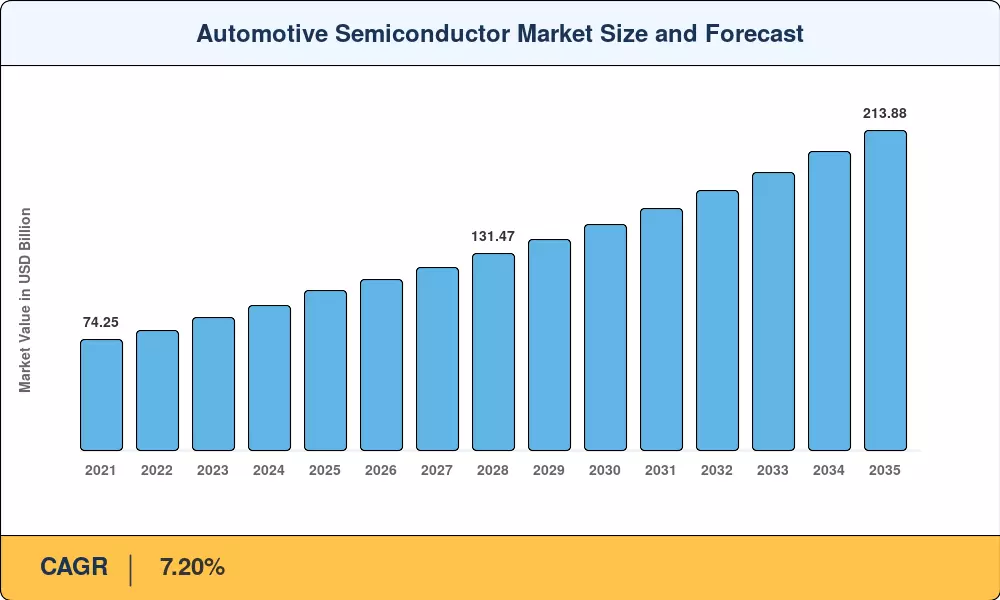
Automotive Semiconductor Market Summary
Asia-Pacific led the Automotive Semiconductor Market with a 42.7% share, while the Middle East & Africa is expected to record the highest regional growth.
Powertrain and electrification captured the largest revenue slice of the Automotive Semiconductor Market at roughly 30.4% in 2025. ADAS are fastest segment growth rate, near 19.1% CAGR, to 2035.”
NY, CA, UNITED STATES, July 3, 2026 /EINPresswire.com/ -- The Automotive Semiconductor Market reached an estimated USD 106.72 Billion in 2025 and is projected to grow from USD 114.40 billion in 2026 to USD 213.88 billion by 2035, registering a CAGR of 7.20% during the forecast period.— Arti Dhapte
Automotive Semiconductor Market Overview
The automotive semiconductor market trends encompasses the design, manufacturing, and distribution of semiconductor devices specifically engineered for automotive applications. These components serve as the electronic brains of modern vehicles, powering everything from engine management and power steering to advanced driver-assistance systems, infotainment, and autonomous driving capabilities. The market includes microcontrollers, sensors, power semiconductors, memory devices, analog and mixed-signal integrated circuits, and optoelectronics that collectively enable the transition from mechanical to software-defined vehicles.
The market is experiencing robust growth driven by the convergence of two transformative forces: zonal electrical-and-electronic architectures that consolidate dozens of discrete ECUs into a handful of high-performance domain controllers, and a global regulatory push mandating advanced safety features across all new passenger cars. The EU General Safety Regulation and China's GB/T standards require advanced emergency braking, lane-keeping, and driver monitoring systems by 2026, compelling automakers to adopt significant semiconductor content. According to the International Energy Agency, global EV sales exceeded 17 million units in 2024, and each battery electric platform requires roughly USD 1,200–1,500 in chip content versus USD 600–700 for a comparable internal-combustion vehicle.
Industry trends indicate a fundamental shift from legacy microcontrollers running isolated functions to system-on-chip platforms capable of over-the-air software updates, real-time sensor fusion, and centralized compute for Level 2+ autonomy. Automakers such as Volkswagen, BMW, and Hyundai are replacing distributed ECU networks with zonal controllers that consolidate wiring harnesses and software domains, reducing E/E hardware costs by 20–30% while tripling the compute budget allocated to central processors. This architectural evolution favors high-performance SoC vendors and creates a winner-take-more dynamic in the automotive semiconductor market.
Technological developments are reshaping the semiconductor landscape at an unprecedented pace. Wide-bandgap power semiconductors—silicon carbide and gallium nitride—offer 40–60% lower switching losses than conventional silicon IGBTs, making them critical for 800-volt EV architectures. Advanced packaging technologies including chiplets, fan-out wafer-level packaging, and 2.5D interposers enable integration of best-in-class IP blocks from various process nodes into a single module, reducing time-to-market by 30% and lowering per-unit costs for mid-tier vehicle segments. The transition from distributed ECU networks to zonal architectures concentrates compute budgets into fewer, higher-value sockets, favoring SoC vendors with strong software ecosystems.
📍 Get Free Sample Report for Detailed Market Insights:
https://www.marketresearchfuture.com/sample_request/10444
Automotive Semiconductor Market Segmentation
By Device Type
The automotive semiconductor market is segmented by device type into Integrated Circuits, Sensors & MEMS, Discrete Semiconductors, and Optoelectronics. Integrated circuits commanded the largest share of market revenue in 2025, reflecting the shift toward centralized-compute architectures. High-performance SoCs from vendors such as Qualcomm, NVIDIA, and Renesas now run advanced sensor-fusion, infotainment, and vehicle-dynamics algorithms on a single chip, compressing the number of discrete components while raising average selling prices substantially. Sensors and MEMS are forecast to expand at a CAGR of 18.8% through 2035, fueled by LiDAR, radar, and in-cabin monitoring proliferation as every new ADAS feature requires additional sensing capabilities. Discrete semiconductors, valued at USD 22.41 billion in 2025, serve power switching for EV inverters, while optoelectronics are growing at 8.9% CAGR through LED and laser-based applications.
By Vehicle Propulsion
Propulsion type segmentation includes Battery Electric Vehicles, Hybrid Electric Vehicles, and Internal Combustion Engine vehicles. Battery electric vehicles accounted for over 50% of the market in 2025, confirming that value growth hinges on chip content per unit rather than production volumes. A single BEV platform can contain over 3,000 semiconductor devices versus roughly 1,500 in a conventional ICE vehicle, translating directly into higher dollar content per unit. Hybrid electric vehicles are growing at 7.8% CAGR through 2035 as transition powertrains require semiconductors for both combustion and electric systems. Internal combustion engine vehicles are projected to post a CAGR of approximately 18.7% through 2035 as even legacy powertrains absorb more silicon for emissions compliance and ADAS retrofit.
By Application
Application segmentation covers Powertrain & Electrification, ADAS & Autonomous Driving, Body Electronics & Comfort, Infotainment & Connectivity, and Chassis & Safety. Powertrain and electrification captured the largest revenue slice at roughly 30.4% in 2025, channeling demand for power MOSFETs, gate drivers, and microcontrollers across both BEV and hybrid platforms. ADAS and autonomous driving are set to achieve the fastest segment growth rate, near 19.1% CAGR to 2035, as OEMs layer additional safety features to meet tightening global regulations. Body electronics and comfort applications value at USD 18.14 billion, covering seat control, lighting, and climate automation. Infotainment and connectivity are growing at 8.4% CAGR with cockpit digitalization and 5G telematics adoption. Chassis and safety applications represent USD 11.74 billion, encompassing ABS, ESC, and airbag control modules.
By Business Model
Business model segmentation includes IDM (Integrated Device Manufacturer), Fabless, and Foundry. IDMs such as Infineon, NXP, and Renesas retain the majority of the automotive semiconductor market with 62.9% share because automotive OEMs value the supply-chain visibility and quality assurance that vertical integration provides. Fabless vendors are gaining ground at 19.7% CAGR by leveraging TSMC's and Samsung Foundry's advanced nodes to deliver high-performance SoCs for ADAS and infotainment at competitive price points. Foundries represent a significant segment valued at USD 8.54 billion, with capacity expansion for automotive nodes accelerating through government-backed initiatives.
🛒 You can buy this market report at:
https://www.marketresearchfuture.com/checkout?currency=one_user-USD&report_id=10444
Automotive Semiconductor Market Regional Analysis
North America
North America represents approximately 24.0% of global market revenue, propelled by CHIPS Act subsidies and autonomous-driving R&D. The United States channels the bulk of regional demand, supported by USD 52.7 billion in CHIPS Act funding and a competitive autonomous-vehicle testing environment spanning Arizona, California, and Texas. Canada's Ontario EV battery belt investments support 6.6% CAGR growth through 2035, while Mexico's USD 2.18 billion market benefits from nearshoring of EV assembly for US OEMs. The Inflation Reduction Act's domestic-content provisions incentivize local semiconductor sourcing for qualifying EV platforms, reinforcing nearshoring trends among Tier-1 suppliers.
Europe
Europe held the second-largest share at roughly 23.0% of global revenue, anchored by Germany's Tier-1 ecosystem and the European Chips Act's commitment to doubling the continent's semiconductor production capacity. Germany accounts for 34.2% of regional revenue through OEM R&D and Infineon/Bosch fab expansions. The UK shows 7.5% CAGR through connected and autonomous vehicle testbeds. France contributes USD 2.62 billion through STMicroelectronics SiC capacity expansion, while Italy's STMicroelectronics Catania fab investment supports regional growth. The European Chips Act's EUR 43 billion mobilization target has catalyzed fab investments in Dresden (TSMC–Bosch–Infineon joint venture), Crolles (STMicroelectronics–GlobalFoundries), and Catania.
Asia-Pacific
Asia-Pacific dominated the automotive semiconductor market with approximately 42.7% of global revenue in 2025. China drives the region with 52.3% of regional revenue, supported by NEV subsidies and domestic fab expansion. India represents a high-growth market at 11.8% CAGR through FAME III and semiconductor mission incentives. Japan's USD 8.94 billion market benefits from Renesas, Rohm, and Denso's established supply ecosystem. South Korea contributes 10.5% of regional revenue through Samsung Foundry's automotive-grade capacity. ASEAN markets show 9.2% CAGR through the Thai-Indonesia EV production corridor, while the rest of Asia-Pacific presents emerging connected-vehicle deployment opportunities.
South America
South America represents a developing market valued at USD 4.27 billion in 2025. Brazil anchors the region with 68.4% of regional revenue through flex-fuel hybrid incentive programs that extend tax incentives to hybrid and plug-in electric drivetrains alongside traditional ethanol flex-fuel vehicles. The country's automotive industry produced over 2.5 million vehicles in 2024, each incorporating incrementally more silicon content. Argentina shows 5.5% CAGR through lithium mining and battery ecosystem development, while the rest of the region experiences gradual electrification of fleets.
Middle East & Africa
The Middle East & Africa emerged as the fastest-growing region, tracking a projected CAGR near 19.4% through 2035. Saudi Arabia leads with 35.8% of regional revenue through Vision 2030 EV assembly investments, including commitments from Lucid Motors and Hyundai. The UAE shows 10.1% CAGR through smart-mobility and autonomous taxi pilots in Abu Dhabi and Dubai. South Africa contributes USD 0.82 billion as a light-vehicle manufacturing hub for Africa, while Egypt shows 8.7% CAGR through CKD assembly growth and localization mandates.
Competitive Landscape / Key Players
The automotive semiconductor market displays medium concentration, with an estimated Herfindahl-Hirschman Index of approximately 900–1,100, indicating a moderately competitive environment. The top five players collectively hold an estimated 45–50% of global revenue. Competition is intensifying as mobile-chip and data-center specialists enter automotive sockets, challenging traditional IDMs that have historically dominated through long-term OEM qualification relationships.
Key companies operating in this market include Infineon Technologies, NXP Semiconductors, Renesas Electronics, Texas Instruments, STMicroelectronics, onsemi, Robert Bosch Semiconductor, Qualcomm, NVIDIA, and Microchip Technology. Infineon leads with an estimated 12–15% revenue share through the broadest automotive portfolio and silicon carbide leadership. NXP Semiconductors holds 10–13% share as a zonal-architecture pioneer with secure connectivity solutions. Renesas Electronics commands 9–12% share with full-stack compute for Japanese and global OEMs. Texas Instruments maintains 8–11% share through broad analog catalog and 300 mm fab cost advantage. STMicroelectronics holds 7–10% share with vertical SiC integration and European Chips Act beneficiary status.
Strategic developments include significant capacity expansion investments, with TSMC confirming automotive-grade N5A process qualification for 5 nm ADAS SoCs in November 2024. The STMicroelectronics–GlobalFoundries joint venture broke ground on a 300 mm FD-SOI fab in France with EUR 7.5 billion in public-private investment. NVIDIA released the DRIVE Thor centralized compute platform delivering 2,000 TOPS of AI performance for Level 3+ autonomous driving applications. onsemi completed acquisition of a SiC substrate facility in South Korea to secure supply for its EliteSiC MOSFET product line.
To explore more market insights, visit us at:
https://www.marketresearchfuture.com/reports/automotive-semiconductor-market-10444
Latest Industry News & Developments
In a significant technology milestone, TSMC confirmed automotive-grade N5A process qualification in November 2024, enabling foundry customers to tape out ADAS SoCs on a 5 nm node for the first time . This development accelerates the availability of advanced-node automotive semiconductors, potentially reducing the performance gap between consumer and automotive chips.
The STMicroelectronics–GlobalFoundries joint venture broke ground on a 300 mm FD-SOI fab in Crolles, France, in September 2024, backed by EUR 7.5 billion in public-private investment under the European Chips Act . This facility represents one of the largest semiconductor investments in Europe and aims to strengthen automotive-grade chip production capacity.
NVIDIA released the DRIVE Thor centralized compute platform in June 2024, delivering 2,000 TOPS of AI performance for Level 3+ autonomous driving applications . The platform consolidates autonomous driving, in-vehicle infotainment, and advanced driver assistance functions into a single system-on-chip, exemplifying the trend toward centralized compute architectures.
onsemi completed the acquisition of a 150 mm SiC substrate facility in South Korea in April 2024, securing long-term supply for its EliteSiC MOSFET product line . This vertical integration move reflects the industry's focus on securing the supply chain for critical wide-bandgap power semiconductors essential to EV traction inverters and onboard chargers.
More Related Reports from MRFR Library:
Larry Wilson
WantStats Research And Media Pvt. Ltd.
+1 855-661-4441
email us here
Visit us on social media:
LinkedIn
Facebook
YouTube
X
Legal Disclaimer:
EIN Presswire provides this news content "as is" without warranty of any kind. We do not accept any responsibility or liability for the accuracy, content, images, videos, licenses, completeness, legality, or reliability of the information contained in this article. If you have any complaints or copyright issues related to this article, kindly contact the author above.
